
By Tom Vickstrom
The Nashville Fire Department of today, like those in most municipalities, can trace its evolution to the influences of technology, population, building materials and methods, government safety codes, and experience. One aspect that has remained constant throughout is the fine character and bravery, the teamwork, and the dedication of the firemen.
In 1806 when Nashville was incorporated the fire fighters were volunteers. Their valor was turbo-charged with a sense of rivalry. A Degree of Honor was awarded to any member of a fire company who reached the engine house first for three consecutive times when the alarm of a fire was given. At this time, water to douse the flames was conveyed by leather buckets holding about three gallons each, one bucket being hung outside each building.
In 1820 Nashville purchased its first fire apparatus, which cost $750, and was pulled to a fire by men hauling ropes. It was about eight feet in length and was connected to a box holding 180 gallons of water that was hand-supplied by buckets. Eight men operated the pumping arms which could shoot a stream of water sixty feet through a three-fourths inch nozzle. Soon a suction-fed version became available. The first two fire engines were given the names of The Cheatham (mayor)and The Rooster, and when called upon, generated a healthy rivalry between the firemen for first arrival on the scene.
By 1858 the volunteers still operated the fire department, which by then was organized into five companies. Early firehoses were made of leather, with copper riveted seams and with the hoses coated with grease to preserve flexibility. It was not until the 1880s–1890s when rubber‑lined, cotton-woven hoses came into use.
“In 1856 a large fire occurred on the square the night of March 15th, by which thirteen houses were destroyed. Black Bob’s Tavern, a notable place for politicians, was among those destroyed. Another destructive fire occurred the same year on July 8th which destroyed eight buildings, including the Masonic Hall. During the following year the courthouse was destroyed, as was also the old Nashville Inn. In 1859 the steamer “Quaker City” burned at the wharf. This boat was loaded with nitrate of potash and on contact with water made heavy explosions. On April 9, 1860, a large fire occurred on Union Street with a loss of $30,000, and on May 21 the St. Cloud Hotel burned.” By 1860 the citizens of Nashville had become greatly concerned over loss of human life and property from fires and demanded a paid fire department, a sentiment that local newspapers editorials heartily endorsed.
Quoting here from Reminiscences and History of Nashville Fire Department, “The first steam fire engine was bought in 1859 and it was named the “Hamilton” in honor of a prominent hardware merchant of the day. Soon after, two more machines were bought and were named “Eclipse” and “Deluge.” Each were drawn by four horses, the driver riding one of the horses going to the fire. In the following year a Hook and Ladder Company was added to the fire service. The staffing of a steam engine crew was comprised of two pipe men, one fireman, one driver, two hose men, and one driver. Each company also included three runners who provided 24/7 coverage.
Nashville installed its first fire alarm telegraph system in 1875, providing a vast upgrade over the customary practice of signaling danger - ringing a bell. Nashville’s largest fire bell was probably the one that hung at the courthouse, weighing 2,100 pounds.
By 1912 the faithful and beloved fire horses were being retired as trucks replaced them. Intelligent and hard-working horses named Buck and Rowdy and Ponce and Echo had served Nashville well. An apparatus at the Geddes Fire Hall showed how, with the push of a button, the harnesses could be dropped onto the horses, and once secured, off they would go down the crest of a hill towards danger. The first automobile for the department was a Marathon, made here in Nashville, and was driven by Chief Rozetta.
Without the need to house and feed horses the functional design of firehalls changed. Some welcome funding became available through Public Works Administration projects during the great economic depression of the mid-1930s. In 1936 Nashville enjoyed christening new buildings for five fire companies. According to one newspaper article, this was an example of how Nashville was using PWA projects for "changing the scenery for the betterment of civic beauty and service." Some fire halls were constructed in the "most modern type of bungalow design," and were planned to house two trucks and two crews with a "modern" workshop in the basement.
Fires continued to be fearsome and deadly. Entire floors of buildings could collapse, as well as brick walls, sometimes engulfing fireman. Smoke inhalation was also deadly. The 1916 fire in East Nashville will never be forgotten. In under five hours, sixty-four acres and 648 buildings were burned by a raging fire advancing at a rate of 42 feet per minute.
During the 20th century expansion of the fire department was significant. By the 1970s a work shift of 24 hours on duty and 48 off was adapted. In 1974 a new division was formed, the Ambulance and Rescue Division, launched with 8 ambulances and 60 personnel. In 1980 a new Communications Center opened. In the 1990s a Water Rescue Squad was added as well as a Hazardous Materials Team.
Today’s Nashville Fire Department protects Davidson County with over 1,500 personnel at 39 active fire stations. Staffing includes active firefighters, civilian EMS personnel, administrative leaders, and support staff. Recruits undergo intensive physical and academic training in order to graduate with both Firefighter II and Advanced Emergency Medical Technician (AEMT) certifications. Modern Facilities on the NFD campus include a live-burn building, draft pits for testing fire engine pumps, and advanced classroom spaces for ongoing medical education.
Some early firehouses still standing in Nashville ae summarized below:
Holly Street Fire Hall (Engine Co. No. 14- functional fire house) 1600 Holly Street in East Nashville. Built in 1914, a neoclassical / Colonial Revival building.
Hillsboro Village Fire Hall (Fire Station No. 16- functional fire house) 2219 21st Avenue South. Built in 1929, Tudor Revival style
James Geddes Engine Co. No. 6 (Adaptive Reuse / Private Space) 629 2nd Avenue South. Built in 1884 –‘85, Victorian-style.
Engine Co. No. 18 Fire Hall (Community Event Space / Studios) 1151 Cahal Avenue in East Nashville. Built in 1930, fully restored in 2015
Fire Hall No. 1 -Germantown Fire Hall (Adaptive reuse) 1312 3rd Avenue North Built in 1936, Tudor Revival architectural style.
Waverly-Belmont Fire Station 2809 12th Avenue South, Built in 1930, Tudor Revival cottage style.
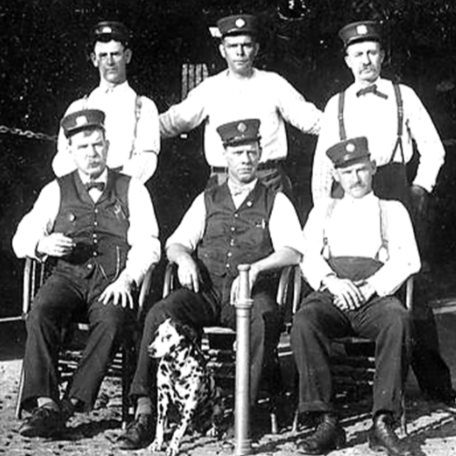
May 1915 Image courtesy of Metro Nashville Government Archives

Dedication of a fire engine named the Anne Dallas Dudley in May 1919 at the Waverly-Belmont Fire Station with Ms. Dudley at the wheel.
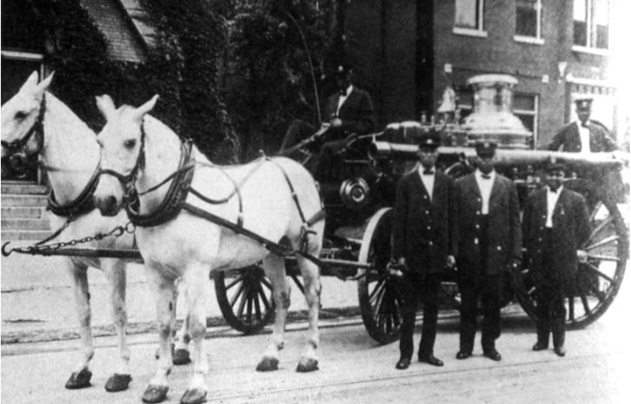
Judi Wells Collection-African American Fire Company, undated Courtesy of Metro Nashville Government Archives
Sources:
Wooding, Thomas Voln, “Reminiscences and History of Nashville Fire Department”, Nashville
Russell, George R., “Nashville Fire Department Commemorative History Book”, Walsworth Publishing Company, Marceline, Missouri, 1997
Meyers, Frank and Gennie, “Nashville Fire Department – Then and Now, Walsworth Publishing Company, Marceline, Missouri, 1975
Hall, Gordon and Maretha, “Fire! On The Scene In Nashville”, The Overmountain Press, Johnson City, Tennessee, 1991
AI search: https://www.google.com/search?q =what are some notable facts about the Nashville fire department?